
Meta launched Muse on 8 September 2026, and Muse is the most ambitious consumer AI agent anyone has shipped. Muse books, buys with single-use cards, fills in forms and works in the background. It lives in its own app, on the web and inside WhatsApp. If you live in the United States and you are comfortable with Meta holding your calendar, your inbox and your purchases, it is worth your attention.
This page is the honest comparison, written by the team behind Yuki. We have included the places Muse is ahead, because a comparison that pretends otherwise is not worth reading.
Can you use Meta Muse outside the United States?
No. Meta Muse is available in the United States only, with no announced date for the UK, the EU or anywhere else.
For most people reading this, that settles the practical question. The gap is not a temporary one you can wait out casually. The EU AI Act and GDPR make a consumer agent that reads your mail, holds a payment card and acts on your behalf a genuinely harder product to launch in Europe than in the US. Google's own agent, Gemini Spark, shipped to more than 160 countries and specifically excluded the EEA, the UK and Switzerland. Europe is not first in line for any of this.
Yuki is built in Europe, for Europe. For EU customers, Yuki processes your email and runs its AI in the EU, and Yuki is available in 23 languages rather than English first.
Side by side
| Feature | Yuki | Meta Muse |
|---|---|---|
| Available in the EU & UK | ||
| Entry paid price | /month | $20/month |
| Card required to start | Yes — card on file on the free tier | |
| Trains its models on your data | Yes, by default | |
| EU data residency (EU customers) | ||
| Independent security audit (CASA Tier 2) | ||
| Languages | 23 | English first |
| Builds your calendar, trips & expenses from your inbox automatically | Reads your mail on request | |
| Trip itineraries built from your own bookings | ||
| AI trip planning (day-by-day draft itinerary) | Can research a trip | |
| Boarding passes & documents kept with the trip, and in Apple Wallet | ||
| A travel map of the countries you have actually been to | ||
| Goals: retirement, house deposit, college fund, a car | 1 on Free, unlimited on Pro | |
| Pace-to-target — what to set aside each month | ||
| Stocks, ETFs, funds & cash tracked as holdings | Free and Pro | |
| Liabilities too — mortgage, credit card, car & student loans | Free and Pro | |
| Net worth across every account and currency | Free and Pro | |
| Essential vs non-essential spending, and where it goes | Answers when asked | |
| Receipt scanning & bank statement import | ||
| Shared groups — 9 types, from couples to gym buddies | ||
| Group polls, shared lists & activity stats | ||
| Expense splitting & settle-up | ||
| Shared calendar — Yuki finds a time that suits everyone | Rolling out | |
| The people in your life — relationships, birthdays, what they like | Remembers what you tell it | |
| Per-connection read-only vs allowed to act | Rolling out | Connect or disconnect |
| Autopilot scoped to a task (limits and trips coming) — and revocable | Rolling out | Approval prompts |
| Browses the open web from a virtual machine | ||
| Buys with a single-use payment card | ||
| Lives inside WhatsApp | Yes, in the US |
Groups: the part Muse structurally cannot copy
Muse is one agent for one person. That is an architectural choice, not a missing feature — there is no second inbox, no shared ledger and no other member for it to coordinate with. Most people's admin is not solo: it is a partner, a flat, a family, a trip, a group of friends who owe each other money.
Yuki ships nine group types, each with its own shape rather than one generic "shared space". The nine are couples, families, co-parents, flatmates, friends, trips, households, a fitness and habit challenge, and a custom type for anything else. Inside a group you get shared tasks and lists, expense splitting with settle-up, polls for the decisions nobody wants to chase, and stats on what the group is actually doing.
Inside a group you also get a shared calendar Yuki can search for a time that suits everyone. There are the birthdays and gifts nobody wants to be the one to forget, and shared goals you are saving towards together. And there are stats that answer the question groups actually argue about: who is pulling their weight.
Money: tracked, not just talked about
Yuki turns receipts and renewal notices into tracked spending, subscriptions and bills without you entering anything, and adds the layer most assistants skip entirely. Set the goals people actually have: retirement, a house deposit, a college fund, a car. Yuki tells you the honest pace: what you would need to set aside each month to land it.
Track what you hold, from individual stocks and ETFs to funds and cash, and the liabilities on the other side of the ledger: mortgage, credit card, car and student loans. Net worth across every account and currency then becomes one honest number rather than a flattering half of one. Yuki also splits what you spend into essential and non-essential, and names your top category and your most expensive day. A scanned paper receipt or an imported bank statement goes into the same picture.
People: the part that is not admin
Yuki keeps the people in your life, not a contact list. For each person Yuki keeps who they are to you, when their birthday is, what they like, what you owe each other and what you have got planned together. One profile shows the groups you share, what is coming up between you and what you have shared before. So "find Mum a gift around €80" starts from something Yuki already knows rather than a guess. Duplicates get merged rather than quietly doubled, and you choose how people can find you — by phone, email, username, or only through a shared group.
Control: an agent you can put on a leash
Every connection is either read-only or allowed to act, and you decide which — Gmail, Google Calendar, Contacts and your device calendar today, with open banking, rides and food delivery rolling out. Autopilot is a ladder rather than a switch: ask me every time, or auto-approve this one task, with a spending limit and a whole-trip setting coming once Yuki can pay and book. Whatever you switch on, high-risk actions such as sending email or large purchases still come back to you for a tap. Every grant is scoped, expiring and revocable from the same screen that made it.
Where is Muse ahead of Yuki?
Muse can act on the open web. It drives a browser inside a virtual machine, which means it can attempt things no integration-based agent can reach: an obscure booking form, a council website, a shop with no API. That is a real capability and Yuki does not have it.
It is also worth knowing what that costs. Meta has said publicly that prompt injection is not a solved problem. An agent that reads untrusted web pages while holding your inbox and a payment card is exactly the situation where it matters. Independent testing by PYMNTS found Muse completed none of three attempted checkouts. Early agentic browsing is impressive and unreliable at the same time, and both halves are true.
Where is Yuki ahead of Muse?
- You can actually use it. Europe, the UK and most of the world, today.
- It costs rather than $20, and asks for no card until you choose to pay.
- It never trains a model on your data, keeps EU customers' data in the EU, and passed an independent CASA Tier 2 assessment in March 2026.
- It works for more than one person: couples, families, flatmates and co-parents share tasks, lists, plans and costs.
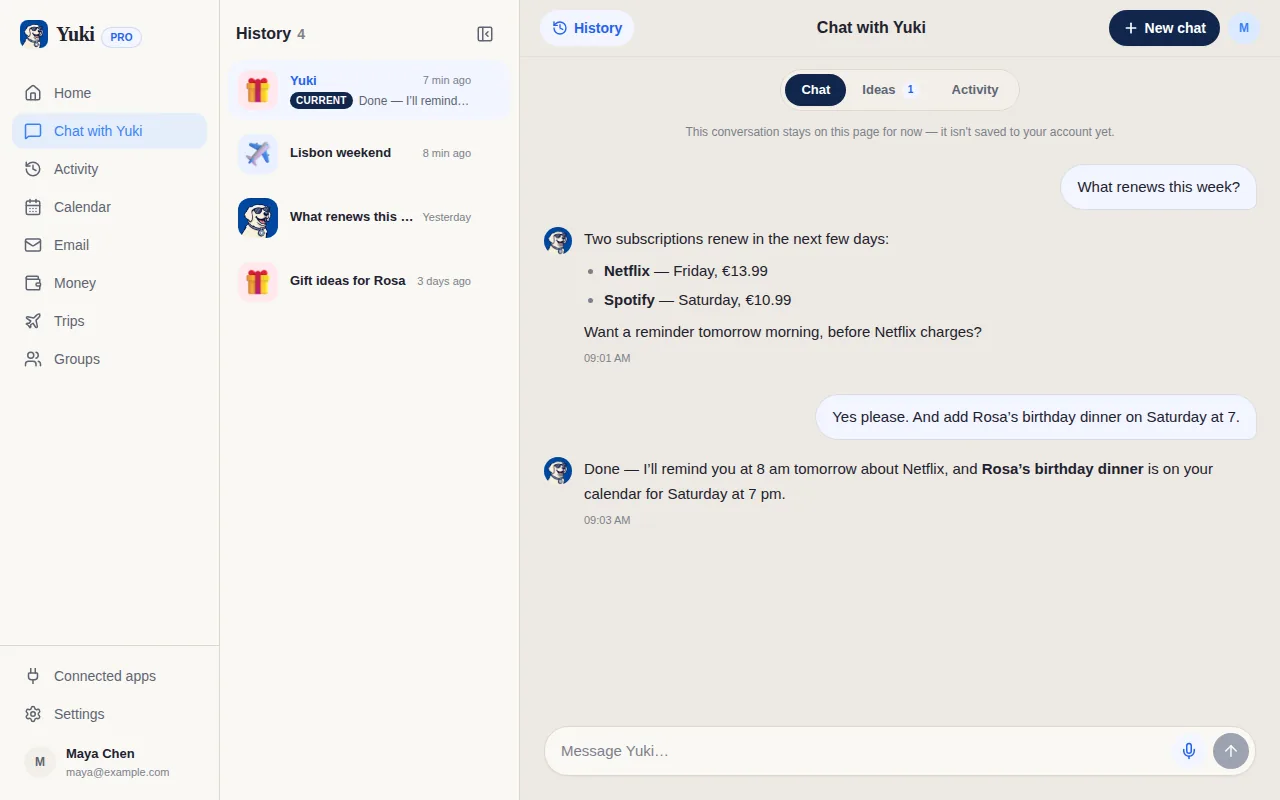
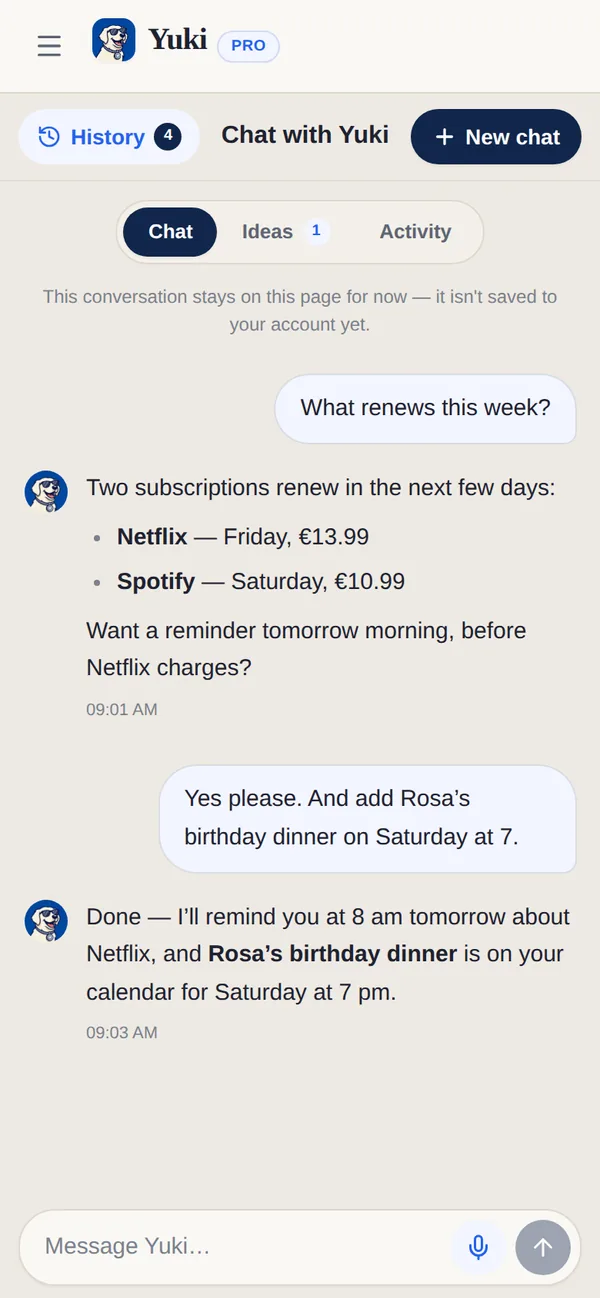
- It builds your calendar, trips and expenses from the confirmations already in your inbox, without being asked each time.
- It tracks the money rather than just discussing it: goals with an honest pace, holdings, liabilities and net worth as one number.
- You decide how far it can go — every connection read-only or allowed to act, and autopilot scoped to a task today, with spending limits and whole trips to come.
- It speaks 23 languages, not English with translations promised later.
The structural difference
Muse is one agent for one person, acting on the open web. Yuki is a coordination layer for a household, acting over typed integrations and your own structured data. That is why Muse can attempt a wider range of one-off tasks. It is also why Yuki can answer "who is picking up the kids on Thursday and who owes what for the weekend", a question Muse has no place to put.
If your life is genuinely solo and entirely inside the United States, Muse is a reasonable thing to try. If you live in Europe, share your life with anyone, or would rather your calendar and inbox were not training data, that is the gap Yuki was built for.
Rolling out now: the agent release
The comparison above is what Yuki does today. The agent release extends Yuki into the ground Muse opened up, on rails that already work end to end in testing. It covers searching real flights and holding a seat before you pay, and booking stays. It connects a bank through open banking, so balances and transactions are live rather than inferred from email. And it plans, books and runs a whole trip from one conversation.