
Forgetting a birthday rarely happens because you don't care — it happens because the reminder arrives too late, or not at all. You remember on the day, when there's no time to order a gift or book a table, or you find out from a group chat two days after the fact. The fix isn't a better memory; it's a system that surfaces occasions in advance and nudges you while you can still act. This guide walks through how to build that system once so you can stop relying on your brain — and how Yuki can quietly run it for you in the background.
Why we forget — and why day-of reminders don't help
Most people already have birthdays saved somewhere — a phone contact, a calendar, a mental note. The problem is timing. A notification that fires at 9am on the day itself tells you it's too late to ship a gift, and often too late to do anything thoughtful at all. By then you're scrambling to write a last-minute message that reads exactly as last-minute as it is.
The second failure mode is fragmentation. Your partner's birthday lives in your head, your mom's is in a contact card, your best friend's is buried in a Facebook memory, and the dinner reservation for your anniversary is a confirmation email you'll never scroll back to find. When the information lives in five places, no single one of them reliably reaches you in time.
The goal is to consolidate every occasion into one place and shift the reminder earlier — far enough ahead that 'remembering' and 'acting' can be the same, calm moment instead of a panic.
Build a single, complete list of dates
Start by collecting every recurring occasion that matters into one list. This is a one-time effort that pays off for years, because birthdays and anniversaries repeat annually — enter them once as recurring events and they never fall off.
Be thorough now so you're not adding names reactively for the rest of your life. A good sweep covers more than you'd expect.
- Immediate family and your partner — birthdays and your own anniversary
- Close friends and their kids' birthdays
- Extended family: parents, siblings, in-laws, grandparents
- Work relationships worth acknowledging — a manager, a close teammate
- Recurring occasions beyond birthdays: wedding anniversaries, memorials, 'we met' dates
- One-off events already in your inbox: invites, RSVPs, save-the-dates
Set the reminder early enough to act
This is the single most important step. For anything that might involve a gift, set your alert 10–14 days out. For a card or a plan (dinner, a call), 5–7 days is enough. For a simple text, the day before is fine. Match the lead time to the effort the occasion deserves.
A useful pattern is a two-stage nudge: an early heads-up ('Mom's birthday in two weeks — order something') and a same-week confirmation ('Mom's birthday Saturday — did you send it?'). The first gives you runway; the second catches anything that slipped.
If you keep your occasions in a calendar, this is where two-way calendar sync matters — an occasion added on your phone should appear everywhere you already look, so you're never depending on a single app you might forget to open. Yuki's calendar writes two-way to Google Calendar, so birthdays and anniversaries show up alongside the rest of your life instead of in a separate silo.
Let your inbox do the remembering for you
Manually maintaining a list is the reliable-but-tedious version. The lower-effort version is to let the confirmations already sitting in your inbox populate the system automatically. Party invites, save-the-dates, RSVP threads and gift-order receipts all carry dates — and they're already arriving in your email.
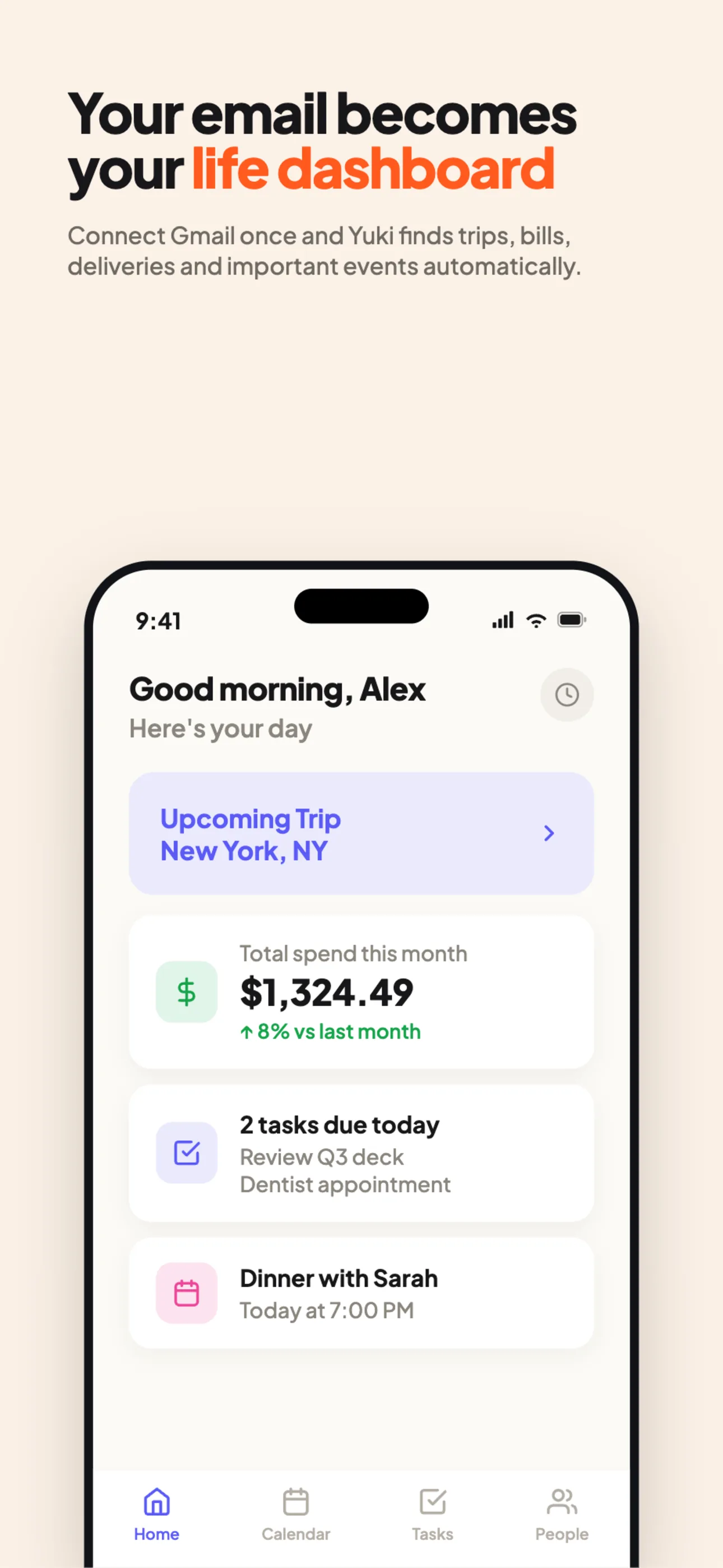
This is where Yuki removes the mental load entirely. It connects to Gmail or Outlook and turns those invites and confirmations into calendar events and reminders without you copying anything over. An invitation that lands in your inbox becomes a dated event you'll actually be reminded about, and a gift you ordered becomes a tracked delivery so you know it'll arrive in time.
You can also just ask. Yuki AI understands natural language, so 'when is my sister's birthday?' or 'what occasions are coming up next month?' gets you an answer without digging — the remembering stops being your job.
Share the load so nobody drops the ball
For couples, families and co-parents, occasions are often a shared responsibility that quietly falls on one person. The classic failure is both partners assuming the other 'has it handled' for a niece's birthday — and neither does.
A shared list fixes this by making the plan visible to everyone. When both people can see the same upcoming occasions, gift ideas and who's covering what, the mental load stops living in one person's head. Yuki's shared groups let couples, families and co-parents keep a common view of birthdays, events and plans — so remembering becomes a team effort instead of a solo one you're silently responsible for.
Step by step
- 1Collect every recurring occasion — family, partner, close friends, in-laws, anniversaries — into one place, entered as annually-recurring events.
- 2For each occasion, set a lead time that matches the effort: 10–14 days for gifts, 5–7 days for cards or plans, 1 day for a text.
- 3Add a two-stage nudge where it matters: an early heads-up to act, plus a same-week confirmation to catch slips.
- 4Connect your email so invites, save-the-dates and RSVPs turn into dated reminders automatically instead of getting buried.
- 5Sync occasions to the calendar you already check daily so reminders reach you where you actually look.
- 6Share the list with your partner or family so responsibility is visible and nothing depends on one person's memory.